Rewind: Undo for agent payments.
When an AI agent buys the wrong thing, there's no easy way to see what happened or get your money back. Rewind helps users understand the decision, report the mistake, and get it resolved.
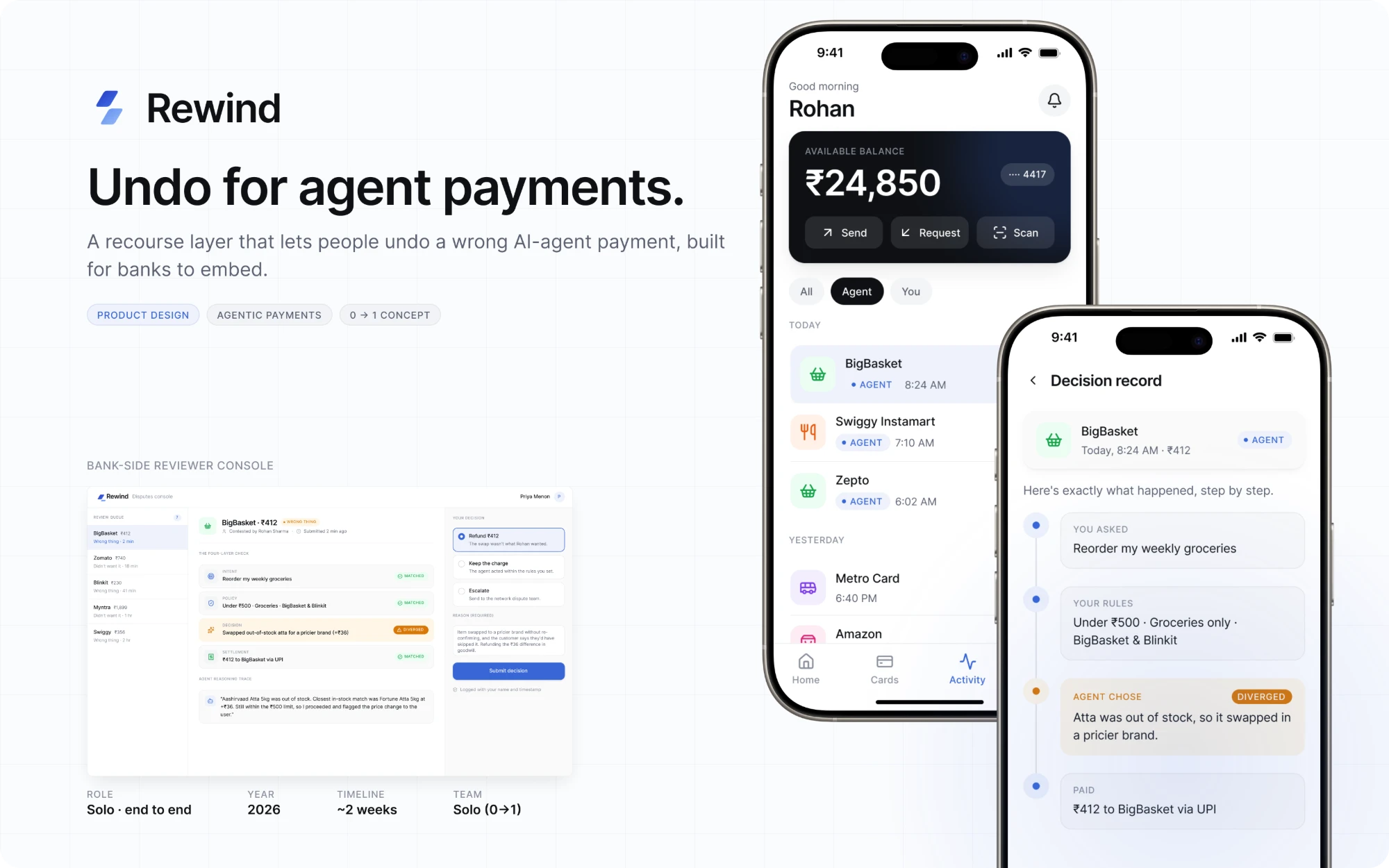
Rewind is a concept for a problem we may soon face more often: AI agents making payments on our behalf. What happens when they buy the wrong thing? Rewind gives people a way to see what happened, question the decision, and get their money back.

Problem
Nobody owns what happens next.
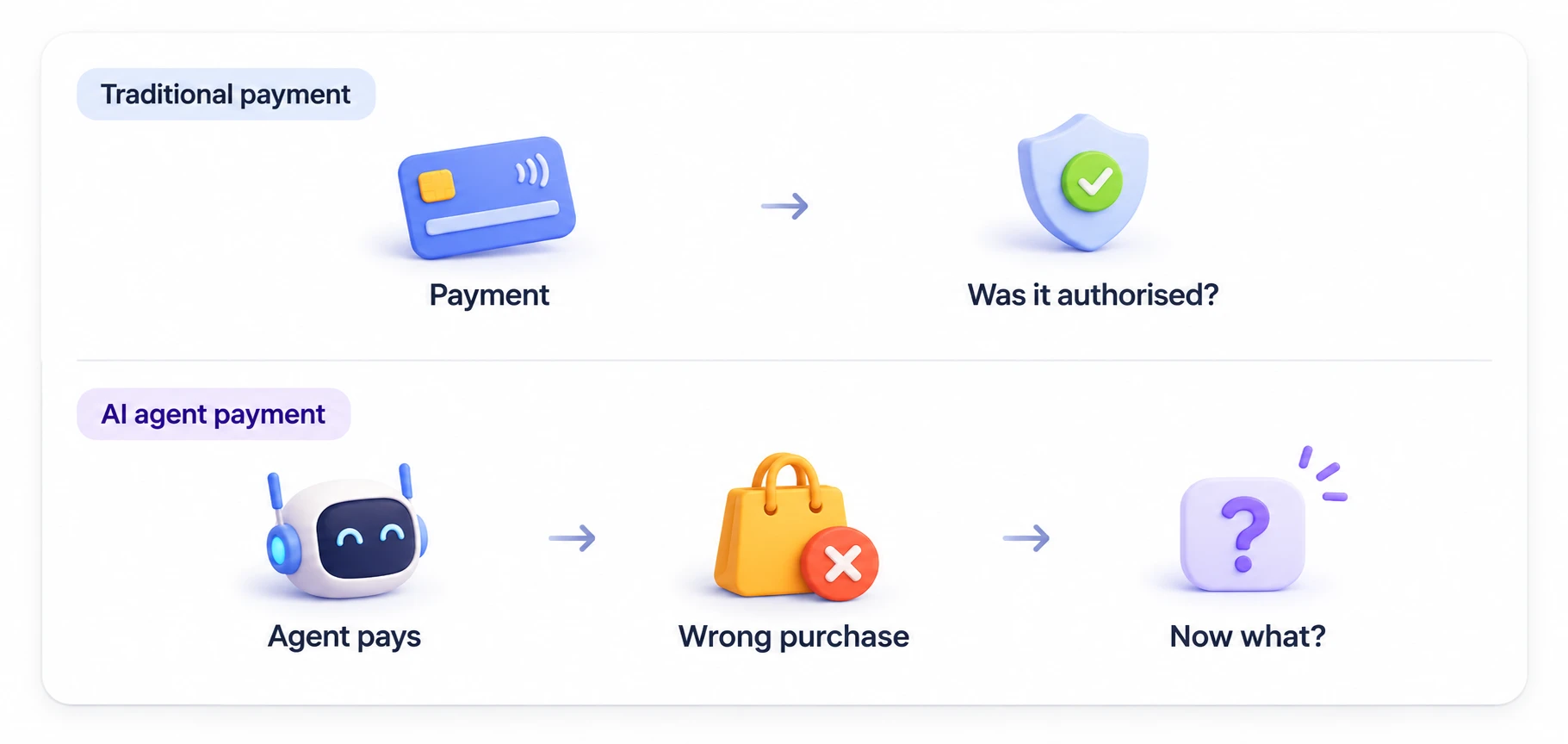
Payment systems can check whether an AI agent was allowed to pay. They have no clear way to handle it when the agent makes the wrong choice.

What I designed
A way to review and question AI payments.
A record of what the agent decided, a way to report mistakes, and a review console for bank teams.

Project status
A two-week, self-initiated concept.
I designed the product flows and interfaces from scratch. Not a shipped product, and not tested with real users.
- Project type
- Self-initiated concept
- Industry
- Fintech · agentic payments
- Timeline
- ~2 weeks
- Year
- 2026
- Team
- Solo (0→1)
- Role
- Solo, end to end. Problem framing, product strategy, the scope cut, every flow, the mobile consumer UI, the bank-side reviewer console, a design system and the brand.
Problem
AI can make payments. But what happens when it gets them wrong?
AI agents are starting to make purchases on people's behalf. You can give them access to your money, set the rules, and let them handle everyday tasks.
But there is a gap. If an agent buys the wrong product, pays the wrong amount, or makes a decision you did not want, how do you question it or get your money back?
Research & users
Who takes responsibility when an agent gets a payment wrong?
An agent can buy on someone's behalf, but nothing says who answers for it when the purchase is wrong. So I started from the people in the moment after, and what each of them needs.
Three parties, one transaction
The customer
Wants to understand what the agent bought, and to get their money back.
The AI agent
Makes purchases from the instructions and the permissions it was given.
The bank
Needs clear evidence before it can review a dispute and resolve it.


What each side needs answered
Customer
- What did my agent buy?
- Why did it buy this?
- Can I get my money back?
Bank
- Was the payment authorised?
- What evidence is available?
- How should I resolve it?
System
- What did the agent decide?
- Can the decision be challenged?
- What happens next?
Product scope
Three parts. One clear way to resolve a wrong purchase.
Rewind had to work for both sides of a dispute, so I built three things: a way to understand what the agent bought, a way to question it, and a way for a bank to review the same evidence.
What I built
Consumer app
See what the agent bought, why it bought it, and whether the purchase was allowed.
Dispute flow
Flag a wrong purchase, explain what went wrong, and send it for review.
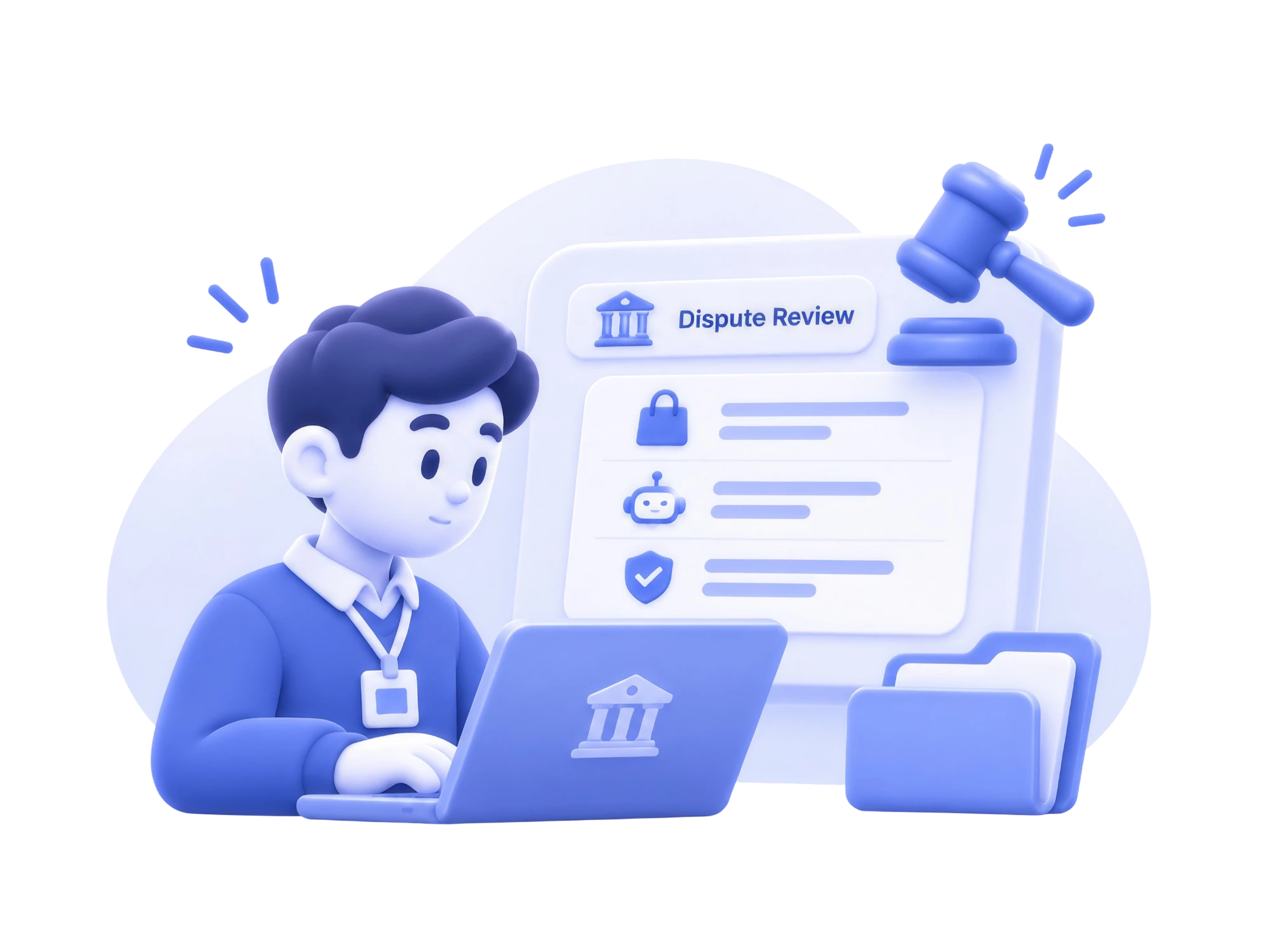
Bank reviewer console
Transaction details, the agent's decision, the permissions it used and the dispute evidence, in one place.
From a wrong purchase to a review
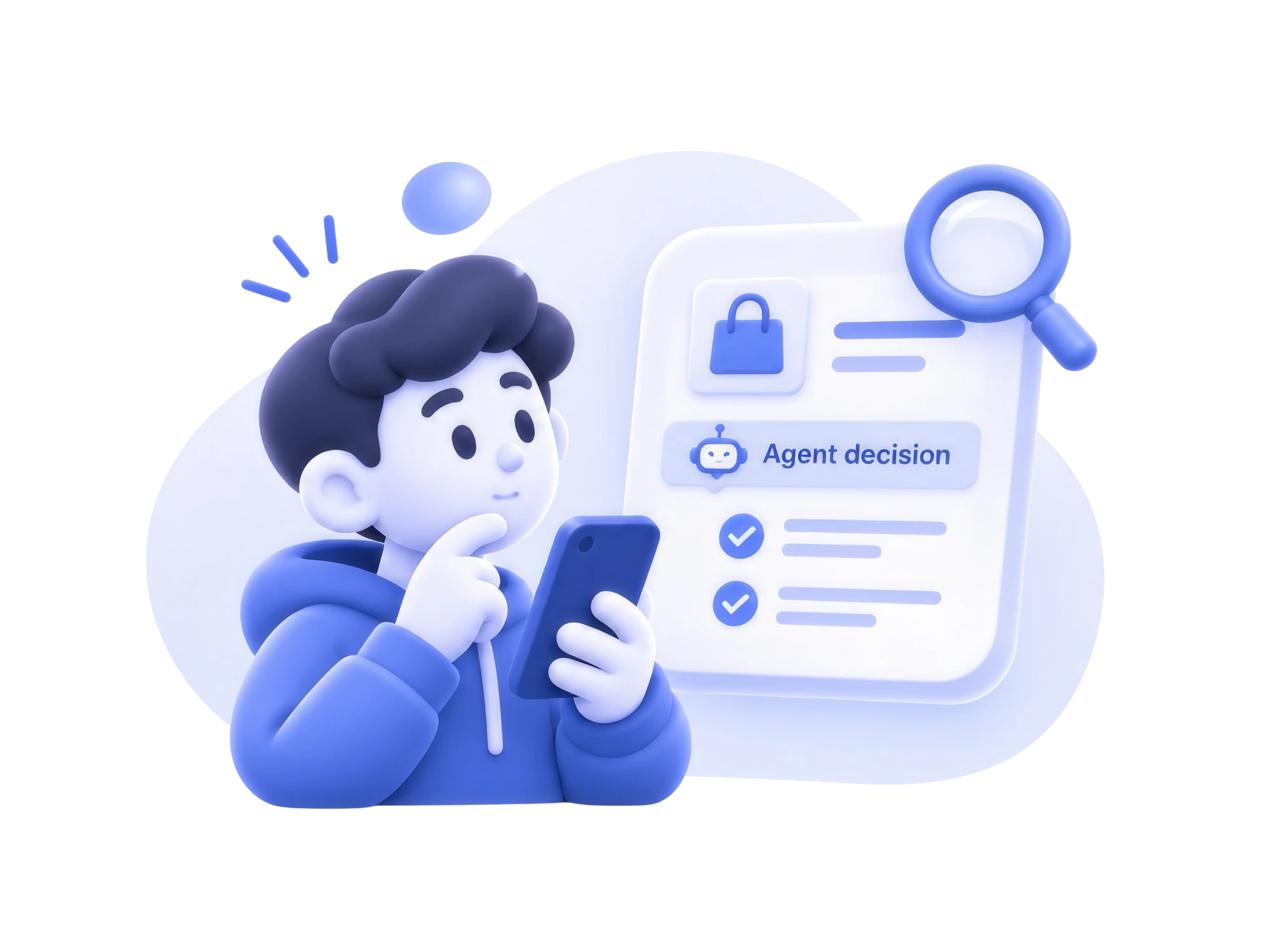
Agent buys
A purchase is made on the customer's behalf.
User reviews
The customer checks what actually happened.
Bank reviews
The dispute is assessed against the same evidence.

What I chose to build, and what I did not
In scope
- Purchase history
- Agent decision records
- Permission history
- Dispute submission
- Bank review console
Not in scope
- Payment processing
- Controlling AI agents
- Automatic refunds
- Merchant checkout
- Replacing bank systems
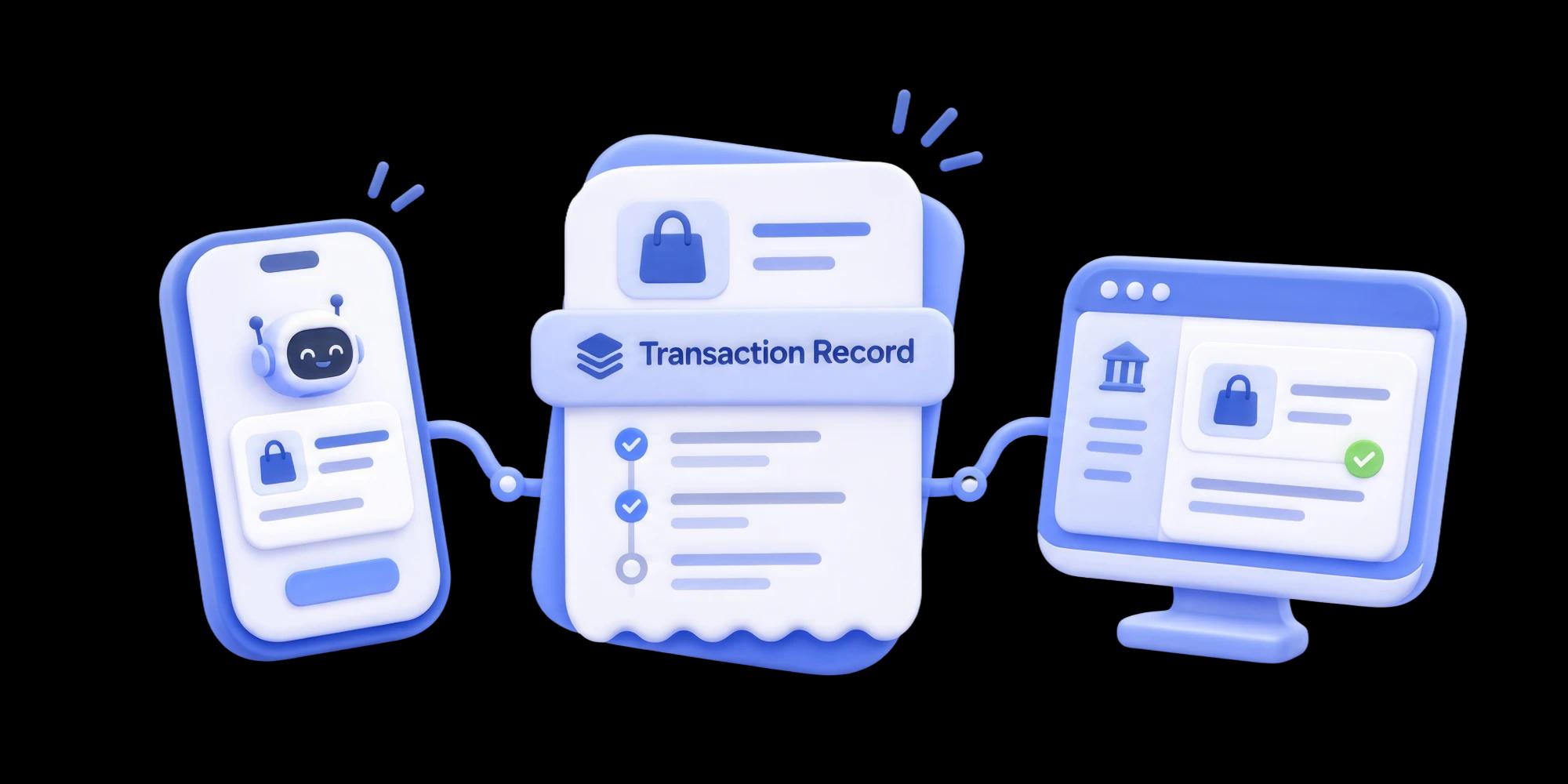
The customer and the bank needed to see the same purchase details. So Rewind is built around a single shared record: the person raising the dispute and the team reviewing it work from the same information, rather than from two accounts of it that have to be reconciled.
How it works
What happens after an agent gets it wrong?
One journey: see what the agent bought, understand why it bought it, and say something when it was wrong.
See the purchase
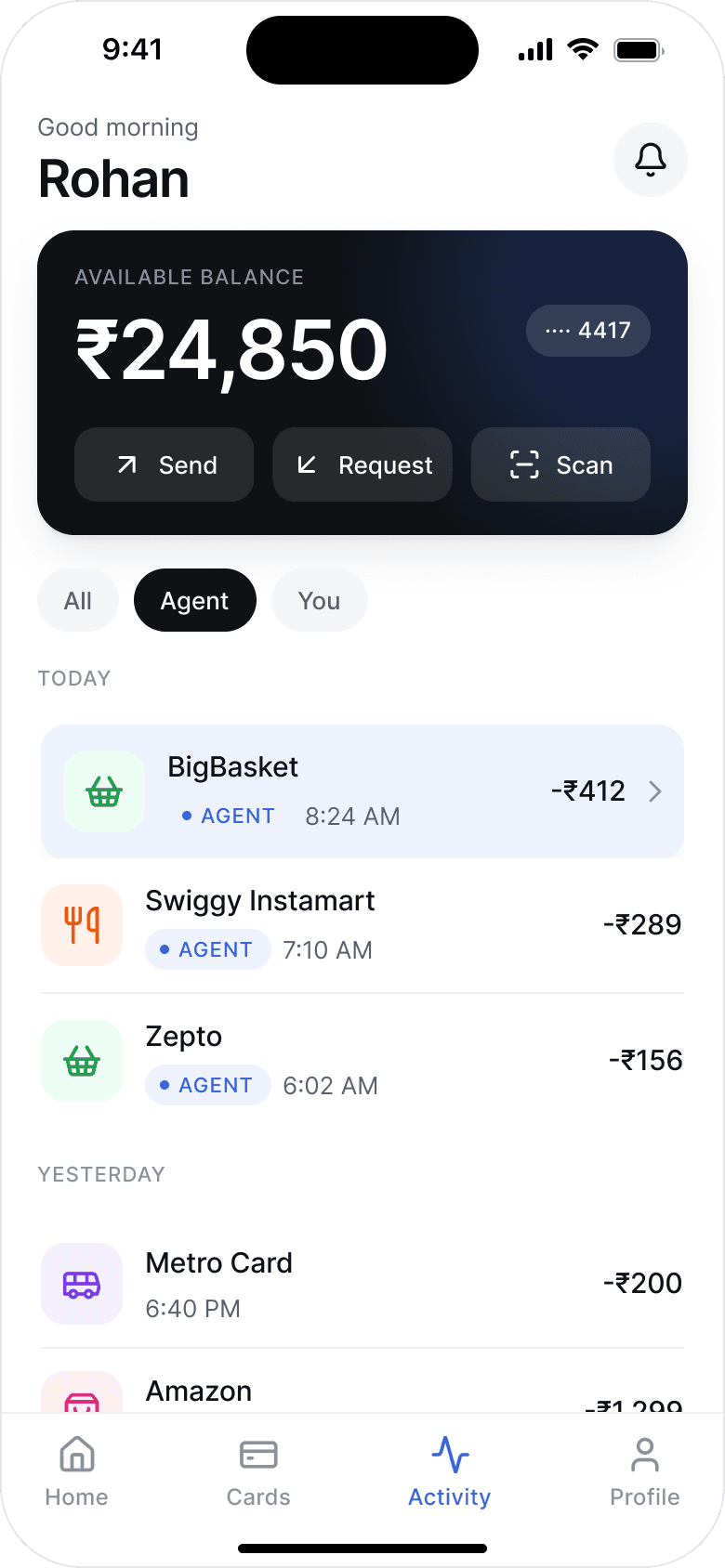
Agent payments sit in the ordinary feed with a small Agent pill on them. Nothing has to be hunted for, and nothing new has to be learned to find it.
Understand what happened
The decision record lays out what was asked, the rules the agent was given, what it actually chose, and what was paid. Four lines, in that order.
Question the purchase
Plain symptoms rather than dispute categories. Somebody who has just been charged for the wrong thing knows what went wrong; they do not know which of a bank's eleven reason codes it is.
Get an answer
A clean mismatch refunds on the spot. A judgment call goes to a person with a 24-hour promise. Sometimes the charge stands, and the screen says why rather than going quiet.
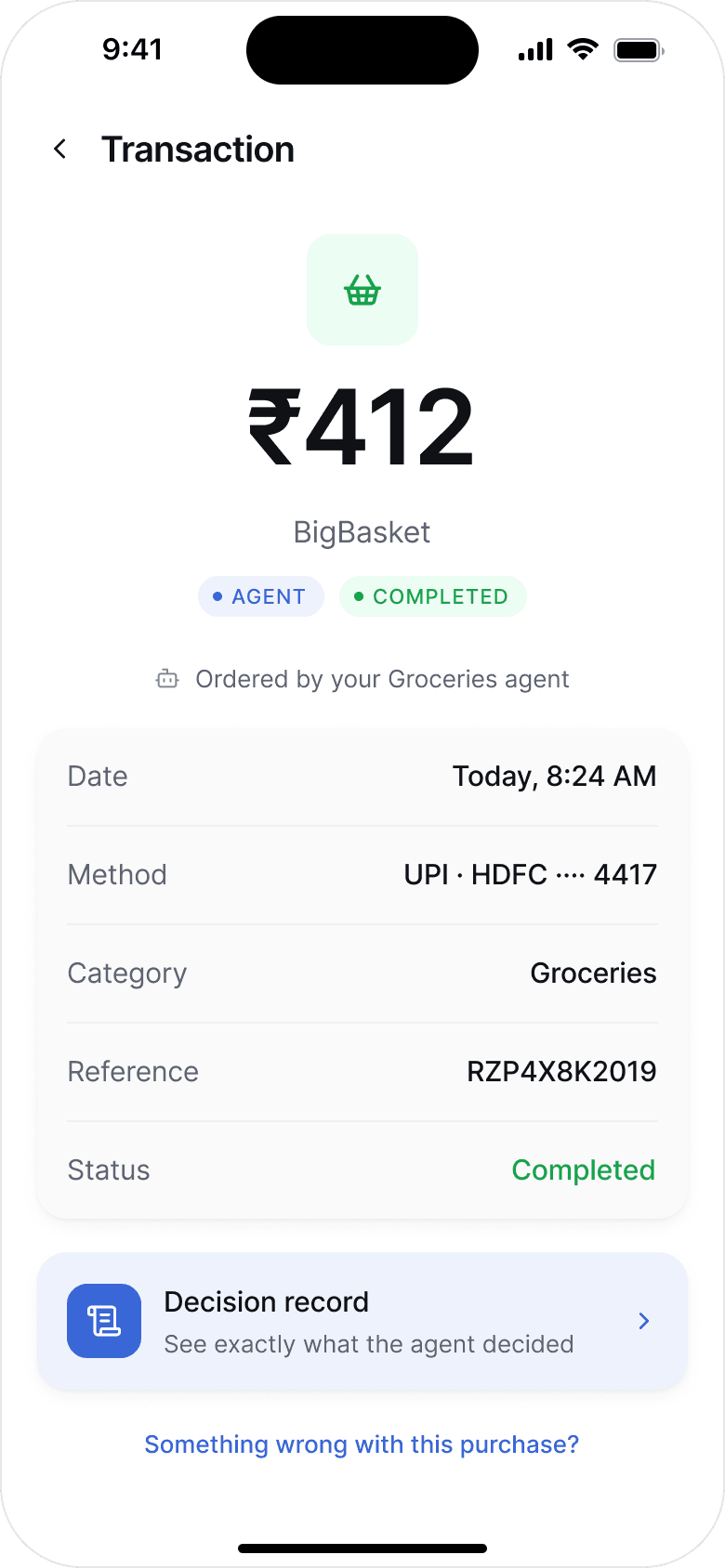
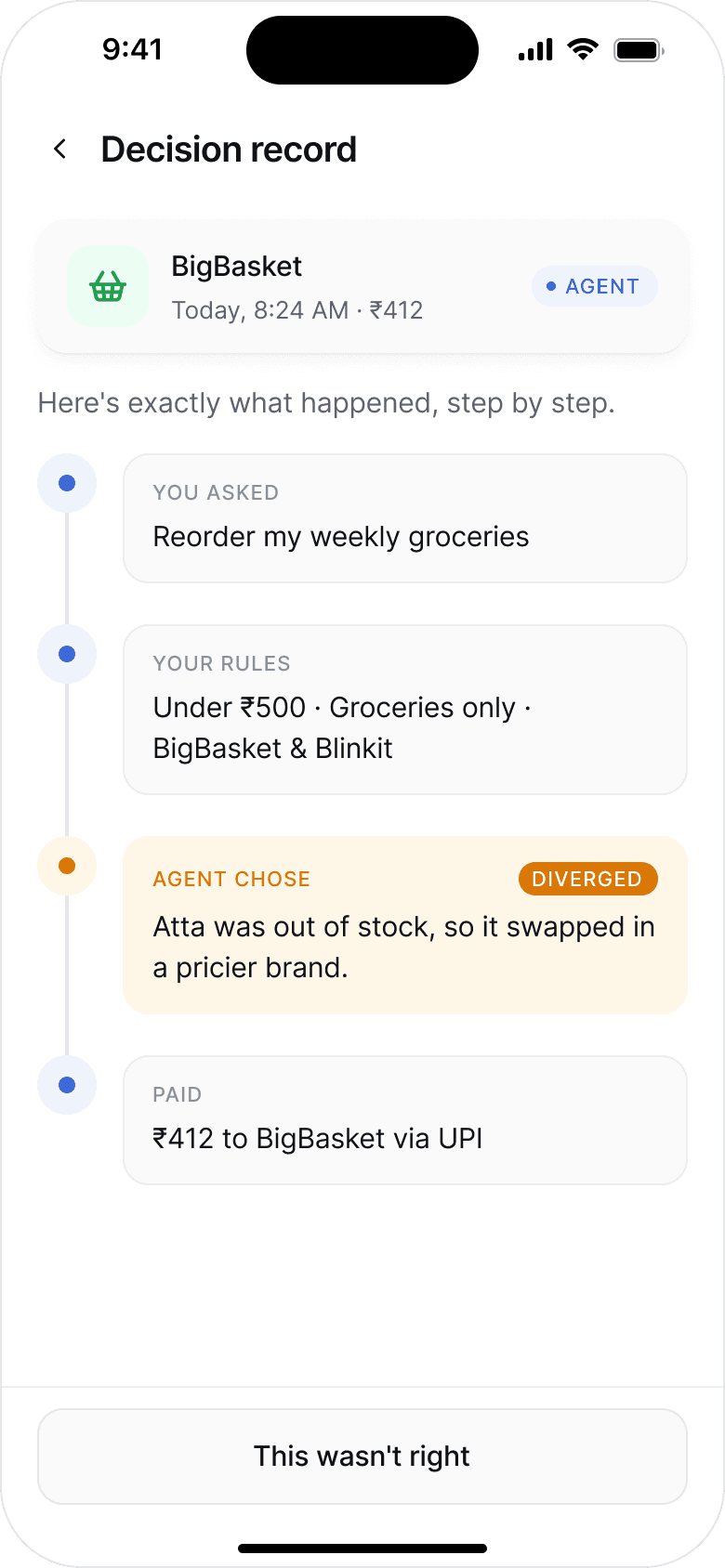
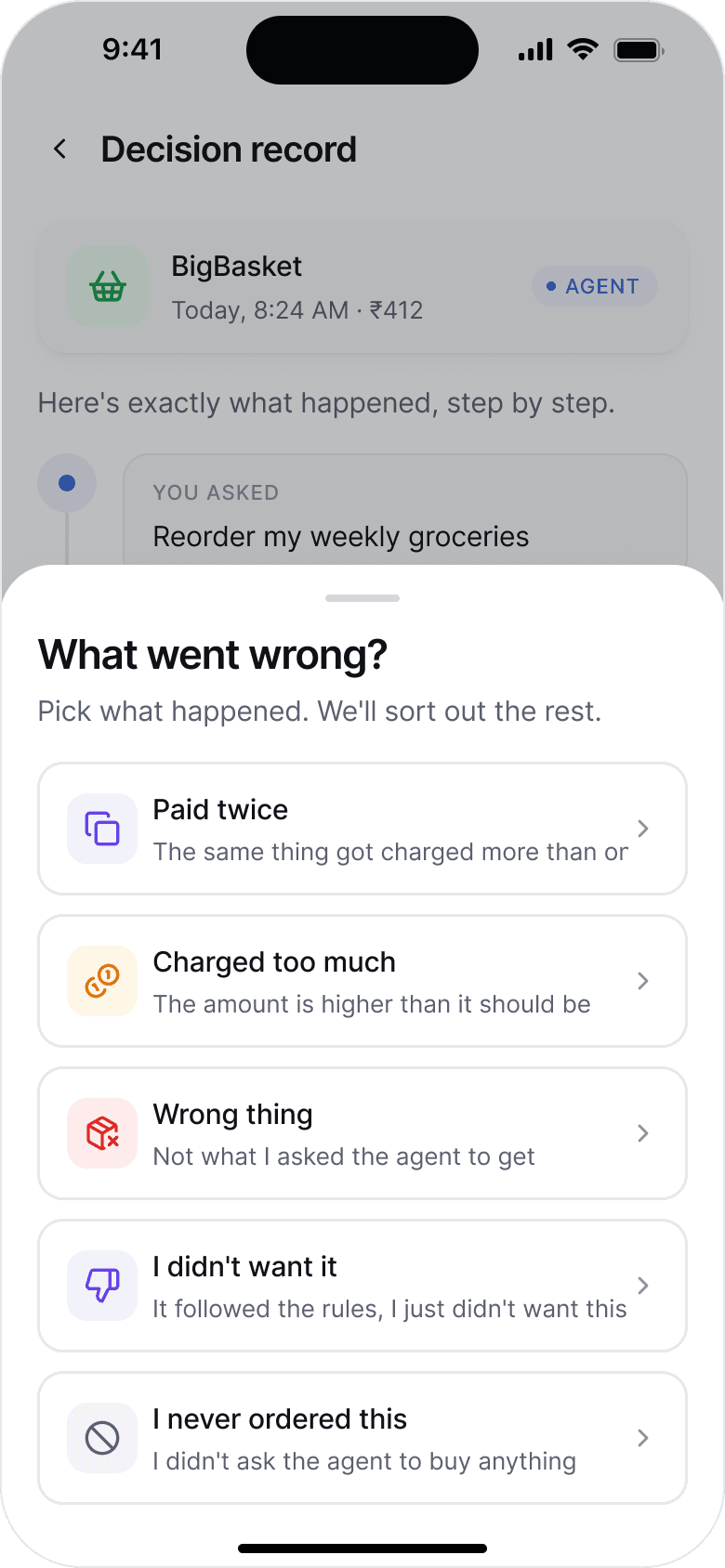
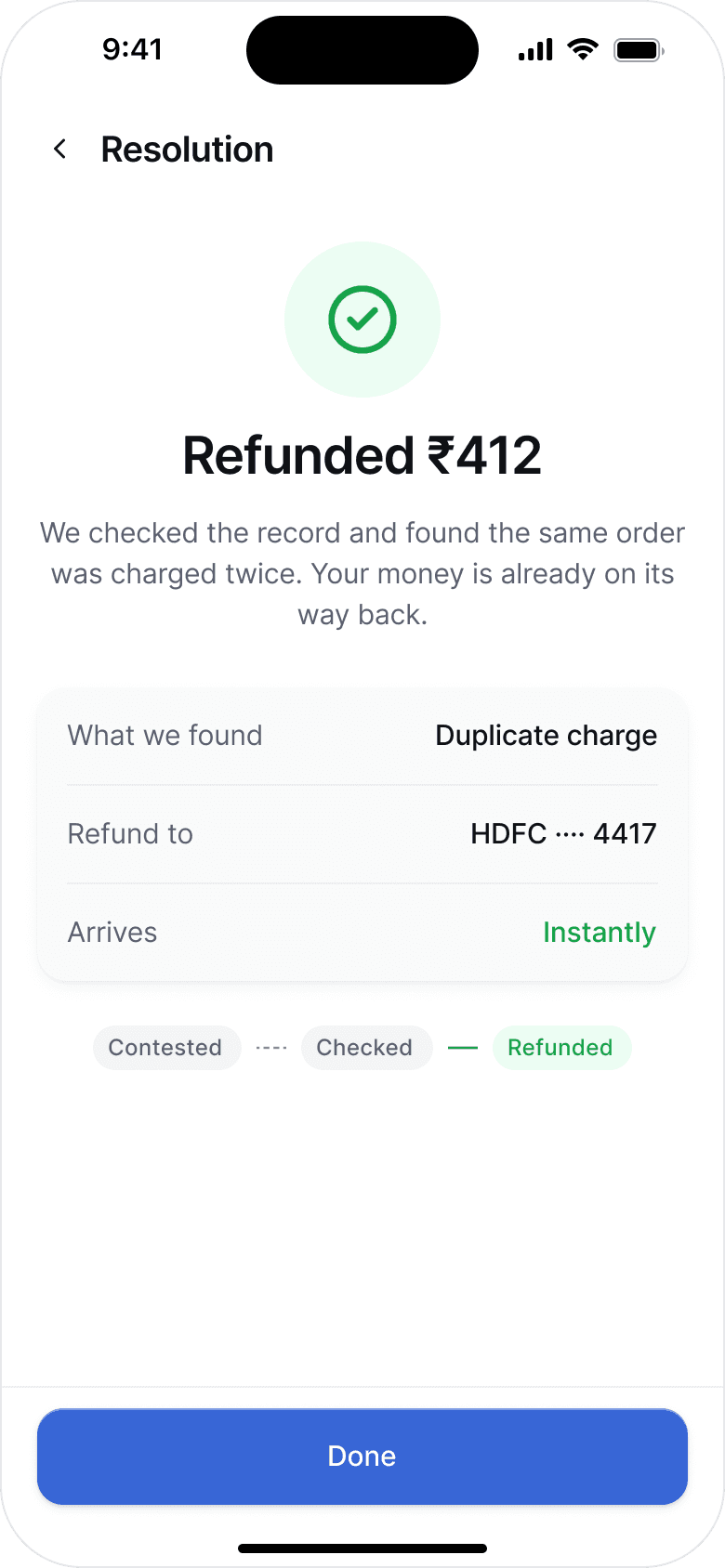
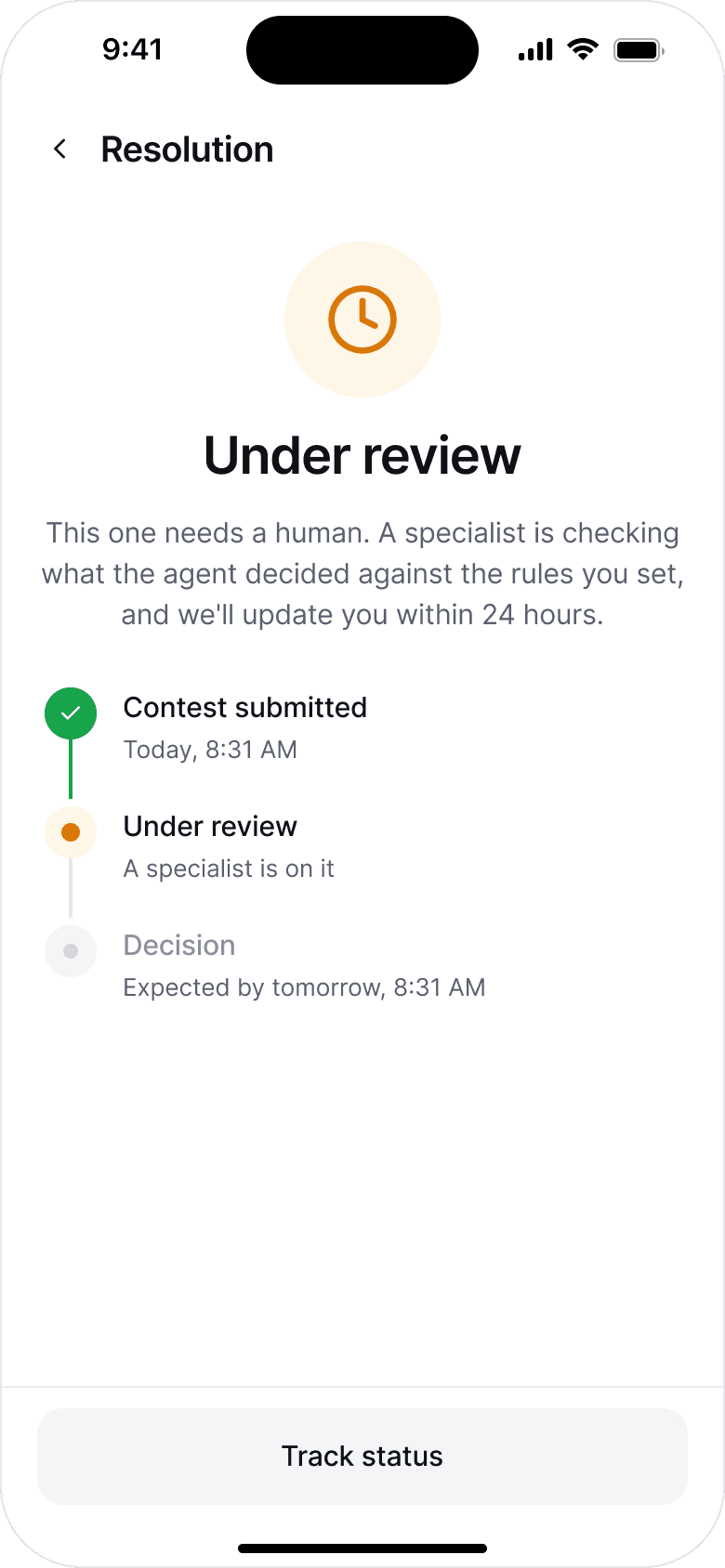
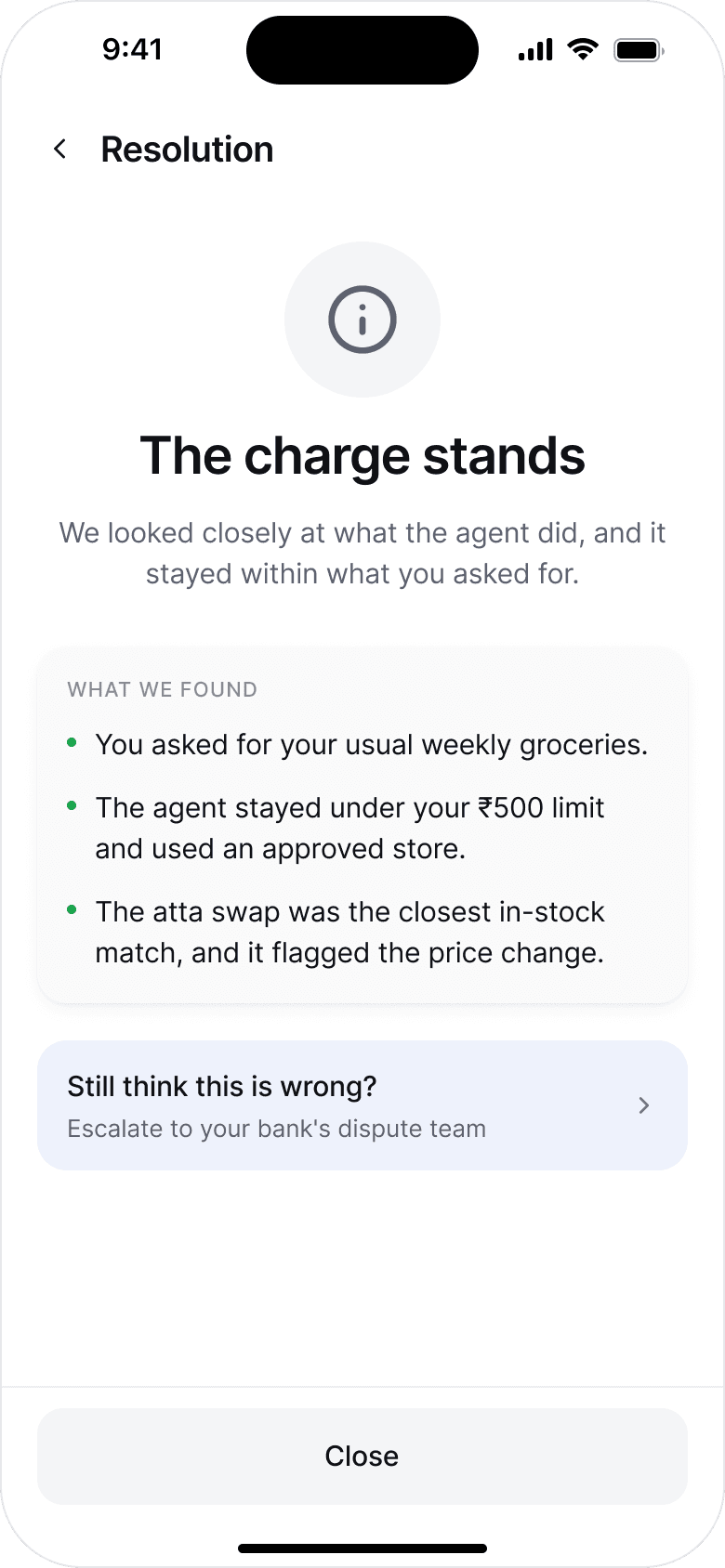
The app is only half of it, because somebody at the bank has to resolve the judgment calls. The instant refunds and the fraud handoffs never reach that queue, which is the point: the tool is supposed to cut a reviewer's dispute load, not add a new source of it.
The layerWhat it held, in this case
Intent
“Reorder my weekly groceries”
Policy
Under ₹500 · groceries · BigBasket and Blinkit
Decision
Swapped out-of-stock atta for a pricier brand, +₹36
Settlement
₹412 to BigBasket via UPI
Three of the four matched. The decision did not, and that one layer is the whole case: the agent stayed inside every rule it was given and still bought something its owner would never have chosen. That is the shape of almost every honest agent dispute, and it is why the record is four layers rather than one verdict.
Design decisions
The decisions behind Rewind
Four calls shaped the product. Each one was about making the thing understandable rather than about adding to it.
01
Show the reason behind every purchase.
An amount and a merchant do not explain why an agent bought something. The record carries the agent's own reasoning, because that is usually the fact that settles the case.
02
Keep the evidence in one place.
Neither the customer nor the bank should have to assemble the story from four screens. Purchase, permissions, decision and timeline sit on one record.
03
Make disputes easy to start.
Nobody should need banking vocabulary to question a purchase. Plain symptoms in, and the system works out which dispute category that actually is.
04
Give the bank the full picture.
A reviewer needs more than a transaction ID to make a call she will have to defend in an audit. She gets the same four layers, with the one that drifted already flagged.
Edge cases
What happens when things do not go as planned?
Real products live or die in the states nobody demos, so these are the four I designed rather than the four I would have liked to skip.
Abandoned
Started, then backed out.
The contest saves as a draft on the transaction, so it can be picked up later instead of started again from the beginning.
Duplicate
Already submitted.
Once a contest is in, it locks. The same complaint cannot be filed twice, and tapping again cannot double up the review queue.
Failure
The refund that does not settle.
A closed account or a bank timeout does not make the refund vanish quietly. It falls back into the review queue with the failure noted on it.
Pattern
The repeat contester.
Somebody contesting a lot of agent purchases is a signal, either a bad agent or misuse. Rewind passes that to the bank's risk team rather than acting on it itself.
What I learned
Designing for a problem that has not fully arrived yet
The hardest part was saying no.
My first instinct was an authorisation layer: the thing that decides whether an agent is allowed to pay at all. That turned out to be already solved, by people with real infrastructure and more leverage than a designer. The actual gap was the unglamorous part nobody wanted, which is what happens after a payment goes wrong.
Trust needs context
Showing what happened matters as much as showing the payment. A charge you cannot explain is a charge you cannot accept.
Design for both sides
A good consumer experience is only half of it. If the reviewer's five minutes with a case do not get easier, a bank has no reason to adopt any of it.
Think past the happy path
The abandoned draft, the duplicate, the refund that fails. Those states are where a payments product is actually judged.
If I did this again I would talk to a real disputes team early, because the whole product lives or dies on whether Priya's five minutes with a case get easier. And if agents are going to spend on our behalf, the recourse has to exist before the mistakes do.
The original
The first version of this case study
The longer, image-led version on my previous portfolio, with the full board set and the research in its original form.
Screens